

An MCB protects the wiring in your walls, so picking the wrong rating can leave cables exposed to damage or leave you with a breaker that trips all day. This guide explains how MCB rating selection works for each type of home circuit. It also covers load calculation, tripping causes, and the mistakes electricians see most often.
An MCB’s current rating, written in amperes (A), is the current it can carry continuously without tripping. If the current stays above that value for long enough, the breaker disconnects the circuit. The rating exists to protect the cable and connected equipment, not just the appliance.
An MCB guards against two faults. Overloads, where too much current flows for too long, are handled by a thermal element. Short circuits, which are sudden and severe, are handled by a magnetic element that trips almost instantly. The rating you choose must fit the wire in the circuit, because the cable is the part you are protecting. Hosper’s MCB range is organised by pole configuration, so you can match the breaker to the type of circuit.
MCB load calculation starts with adding up what a circuit will run, then converting that to current. For simple resistive loads on a single-phase supply, current equals power divided by voltage. Home supply is commonly 230 V, though your installation details matter.
Take a 2,000 W water heater on 230 V. That draws roughly 8.7 A. This figure is where the calculation starts, not the answer. Motors, compressors, and some electronics have power factors and starting surges, so their running current can differ from a simple watt-to-amp conversion. The breaker rating must sit above the expected load current. It must also stay within what the cable can safely carry.
Load alone never decides the rating. Cable size, how it is installed, room temperature, and how many cables run together all reduce the current a wire can safely carry. A qualified electrician accounts for these factors.
Each home circuit has a different job, so the right Miniature Circuit Breaker (MCB) rating depends on the connected load, expected current, cable capacity and starting current of the appliances. Lighting circuits generally carry smaller loads, while kitchen appliances, air conditioners and geysers may require dedicated circuits. No single MCB rating is suitable for every home circuit.
The following table provides indicative appliance-wise selection examples. The final rating, trip curve and wire size must be verified against the appliance manufacturer’s instructions, applicable electrical standards and actual installation conditions.
| Appliance Name | Appliance Load (Wattage) | MCB Rating with Curve |
| LED Bulb / Lighting | 50–300 W | B6 / B10 |
| Ceiling Fan | 50–100 W per fan | B6 / B10 |
| Television | 80–200 W | B6 / B10 |
| Refrigerator | 150–500 W running | C10 / C16 |
| Washing Machine | 500–2,000 W | B16 / C16 |
| Microwave Oven | 1,000–2,000 W | B16 / C16 |
| Electric Geyser | 1,500–3,000 W | B16 / B20 |
| 1-Ton AC | 900–1,500 W running | C16 (check manufacturer specification) |
An MCB’s trip curve determines how it responds to high current, including appliance starting surges.
The correct curve depends on starting current, fault levels and circuit design. Do not choose a higher curve type simply to prevent repeated tripping. Always check the manufacturer’s specifications and consult a qualified electrician.
An MCB must protect the wiring against excessive current. If its rating exceeds the cable’s safe current-carrying capacity, the wire may overheat before the breaker trips.
Wire capacity depends on its cross-sectional area, material, insulation, installation method, temperature and cable grouping. Therefore, wire size alone does not determine the correct MCB rating.
| Wire Size | Ampere Rating* | Approx. Load Capacity | Recommended MCB Rating* |
| 1.0 mm² | 6A | 1.38 kW | 6A |
| 1.5 mm² | 10A | 2.30 kW | 6A / 10A |
| 2.5 mm² | 16A | 3.68 kW | 16A |
| 4 mm² | 25A | 5.75 kW | 20A / 25A |
| 6 mm² | 32A | 7.36 kW | 25A / 32A |
Before selecting an MCB, verify:
A higher-rated MCB does not increase a wire’s capacity. If an MCB trips repeatedly, identify the underlying cause rather than simply increasing its rating. A qualified electrician should verify the complete circuit before installation.
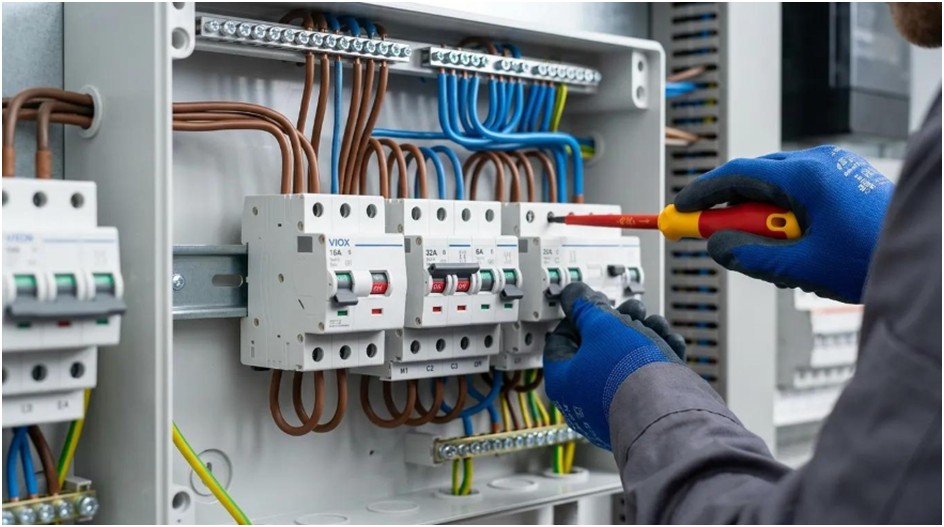
An MCB (Miniature Circuit Breaker) trips repeatedly when it detects an overload or a short circuit. Frequent tripping can also indicate loose electrical connections, damaged wiring or a faulty appliance. Although an occasional trip may occur when a circuit is overloaded, repeated trips should never be ignored.
An overload occurs when the total current drawn by appliances exceeds what the circuit can safely handle. For example, running several high-power appliances on the same circuit may cause the MCB to trip after a period of use.
A short circuit occurs when conductors make an unintended connection, causing a sudden increase in current. Damaged insulation, defective wiring or faulty electrical equipment can cause this problem. A short circuit often makes the MCB trip immediately.
Loose terminals can create resistance and excessive heat at electrical connections. This may cause intermittent faults, overheating or repeated tripping. Such connections require inspection by a qualified electrician.
An appliance with damaged wiring, an internal electrical fault or an abnormal current draw may repeatedly trip the circuit breaker. If the problem occurs when a particular appliance is used, that appliance may need professional testing.
An MCB that is unsuitable for the circuit load or an appliance’s starting current may trip unnecessarily. However, the breaker may also be correctly identifying a genuine fault. The rating and trip curve must be checked alongside the cable capacity and circuit design.
Observe when the tripping occurs without opening the distribution board or touching exposed electrical components.
These signs are clues, not definitive diagnoses. A qualified electrician can test the circuit, inspect connections, check the appliance and verify that the MCB is appropriate for the installation.
No. Installing a higher-rated MCB without checking the circuit can be dangerous. If the existing wiring cannot safely carry the higher current, the cable may overheat before the breaker disconnects the supply.
The MCB rating must be coordinated with the circuit’s design current and the cable’s current-carrying capacity. Cable capacity depends on its material, cross-sectional area, insulation, installation method, ambient temperature and grouping with other cables.
For example, replacing a 10A MCB with a 16A MCB is not automatically a safe solution simply because the existing breaker keeps tripping. An electrician must first identify the cause and verify whether the wiring, protective devices and circuit design support the proposed rating.
If the MCB trips repeatedly, do not keep resetting it or bypass its protection. Stop using the affected circuit if you suspect a fault, and arrange an inspection by a qualified electrician. If you notice burning smells, sparks, smoke or unusual heat, keep away from the equipment and seek urgent professional assistance.
The riskiest mistake is fitting an MCB rated higher than the cable can handle. The wire can overheat before the breaker ever trips. Other common errors are ignoring breaking capacity, choosing the wrong trip curve, and sizing from appliance load alone.
Watch for these:
For three-phase installations, check options such as the TPN MCB, TP MCB, and four-pole MCB. Confirm specifications on each product page before you buy.
No. An MCB protects against overloads and short circuits, not earth-leakage shock. A residual-current device (RCD, often called an RCCB or ELCB in India) detects current leaking to earth and trips at very low leakage levels. The two devices do different jobs.
A home needs both kinds of protection working together. An MCB stops cables from overheating. An RCD reduces the risk of a dangerous shock if someone touches a live part or a fault sends current through the body. Some boards combine both in one device, such as an RCBO. Ask your electrician which arrangement suits each circuit. A well-planned distribution box keeps these devices organised and easy to identify.
Selecting an MCB means assessing the circuit, the cable, the installation conditions, and the fault level. A qualified electrician does this against applicable Indian standards and wiring rules. The checks are simple for a professional and risky to guess.
Look for MCBs that carry the required BIS certification, and keep the manufacturer’s documentation. Specifications vary between products, so confirm ratings, breaking capacity, and approvals on the product page or with Hosper directly. Electricians and contractors planning a larger project can book electrical distribution support, and dealers can explore the dealership programme.
Ready to compare options? Browse the full MCBs and distribution boxes range, or contact the Hosper team with your circuit details.